If you are sourcing zinc alloy die casting components for automotive systems, electronic enclosures, or industrial hardware, you have likely encountered the Zamak family of alloys. Understanding the distinct characteristics of Zamak 2, Zamak 3, and Zamak 5 is essential for making informed procurement decisions that balance performance, cost, and manufacturability.
As a specialized zinc alloy die casting factory, we produce precision components using all three alloys. This guide will help you identify which parts are best suited for each material and how our custom zinc die casting services can meet your exact specifications.
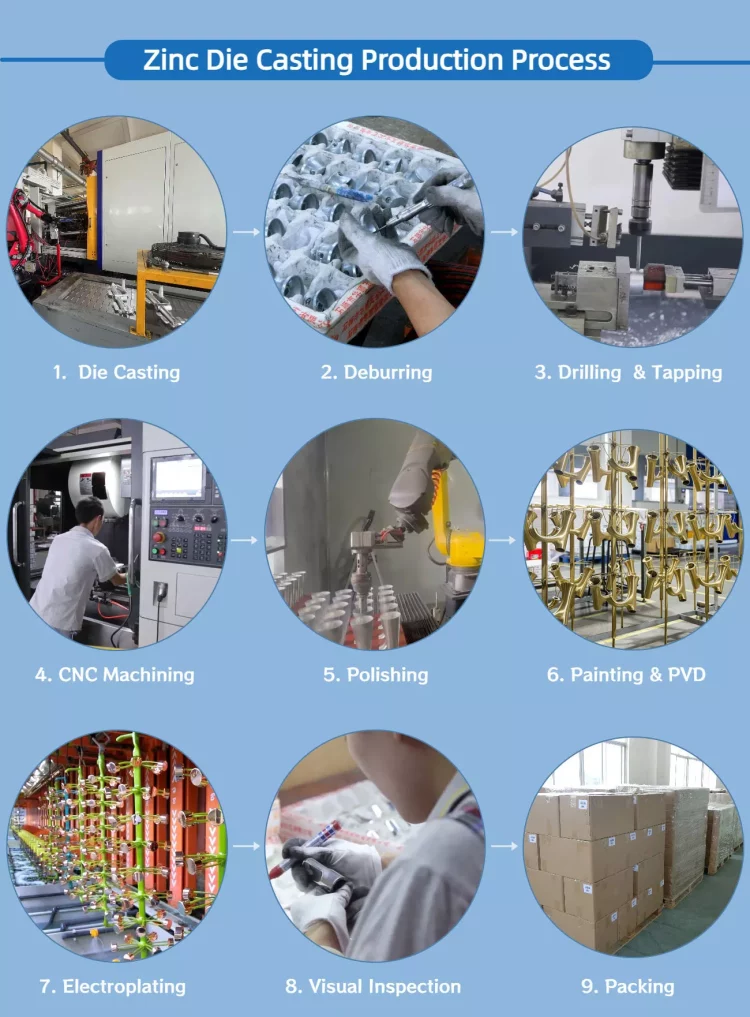
zinc die casting process
Understanding the Zamak Family
Zamak alloys—whose name derives from Zinc, Aluminum, Magnesium, and Copper (the German “Kupfer”)—are the most widely used materials for zinc die casting manufacturing. Their low melting point (approximately 385°C), excellent fluidity, and dimensional stability make them ideal for high-volume production of complex parts .
The table below shows the nominal compositions of the three alloys we frequently work with:
| Alloy | Aluminum | Copper | Magnesium | Zinc |
|---|---|---|---|---|
| Zamak 2 | 4% | 3% | 0.04% | Balance |
| Zamak 3 | 4% | 0.25% max | 0.04% | Balance |
| Zamak 5 | 4% | 1% | 0.04% | Balance |
Zamak 2: The High-Strength Choice for Demanding Applications
Zamak 2 (also known as Kirksite) is the strongest and hardest alloy in the standard Zamak family. Its elevated copper content (3%) provides superior mechanical properties, making it the material of choice for components that must withstand significant stress .
Typical Zamak 2 Components
Due to its excellent wear resistance and dimensional stability, Zamak 2 die casting is specified for:
-
Automotive transmission parts – Components requiring high strength and resistance to mechanical fatigue
-
Aerospace fittings – Non-structural interior components that demand reliability under load
-
Industrial machinery components – Gears, bushings, and bearing retainers where wear resistance is critical
-
Heavy-duty hardware – Lock bodies, door closer mechanisms, and high-use hinges
One manufacturer notes that Zamak 2 offers tensile strength approaching 380 MPa, significantly higher than standard Zamak 3 . This makes it suitable for “high-load components requiring structural integrity and heat resistance” .
When to Specify Zamak 2
Choose Zamak 2 custom parts when your application requires maximum strength and hardness within the Zamak family. However, be aware that the higher copper content reduces ductility slightly and increases material cost compared to Zamak 3 . Our engineering team can help you determine whether the performance benefits justify the premium for your specific zinc alloy casting project.
Zamak 3: The Industry Standard for General-Purpose Die Casting
Zamak 3 is the baseline material for precision zinc die casting and represents the majority of components produced worldwide. It offers an exceptional balance of mechanical properties, castability, and cost-effectiveness .
Why Zamak 3 Dominates the Market
According to industry data, Zamak 3 is “the most widely used Zamak alloy, offering an optimal balance of performance and cost” . Its popularity stems from:
-
Excellent fluidity – Allows for thin-walled and intricate designs
-
Superior dimensional accuracy – Maintains tight tolerances even in complex geometries
-
Outstanding surface finish – Accepts plating, painting, and powder coating exceptionally well
-
Good corrosion resistance – Performs reliably in indoor and protected environments
Common Zamak 3 Applications
Our custom zinc alloy die casting factory produces thousands of Zamak 3 components annually across multiple industries:
Automotive Interior and Trim
-
Door handle frames and bezels
-
Interior mirror housings
-
Gear shift knob components
-
Vent control levers
Zamak 3’s ability to reproduce fine detail makes it ideal for decorative automotive trim that must match interior aesthetics .
Consumer Goods and Hardware
-
Cabinet handles and knobs
-
Lock cylinders and escutcheons
-
Furniture fittings
-
Small appliance housings
The alloy’s “excellent dimensional accuracy” and “superior surface finish” ensure that consumer products meet both functional and aesthetic requirements.
Electronics and Electrical Components
-
Connector housings
-
Switch bodies
-
Sensor enclosures
-
EMI shielding components
Zamak 3 provides natural electromagnetic interference shielding while maintaining the precision required for electronic assemblies .
Plumbing and Fittings
-
Faucet handles
-
Valve trim
-
Showerhead components
-
Drain assemblies
The corrosion resistance of Zamak 3 makes it suitable for plumbing applications where exposure to water is expected .
Production Advantages
For high-volume zinc die casting manufacturing, Zamak 3 offers significant processing benefits. Its predictable solidification and minimal shrinkage reduce scrap rates and ensure consistent quality across millions of parts. As one source notes, Zamak 3 is “usually the first choice when considering zinc for die casting for a number of reasons” .
Zamak 5: Enhanced Strength for Demanding Environments
Zamak 5 (also designated as Zamak 5 or AC41A) modifies the standard Zamak 3 composition by adding 1% copper. This addition increases tensile strength by approximately 10-15% and improves hardness and creep resistance . In fact, Zamak 5 is “the most widely used zinc alloy in Europe” .
Where Zamak 5 Excels
The enhanced properties of Zamak 5 make it particularly suitable for components exposed to:
-
Elevated temperatures – Better creep resistance than Zamak 3
-
Mechanical stress – Higher strength for load-bearing applications
-
Wear conditions – Improved surface hardness for moving parts
-
Outdoor environments – Enhanced corrosion resistance from copper addition
Typical Zamak 5 Components
Our zinc alloy die casting services frequently produce Zamak 5 parts for:
Automotive Under-Hood and Chassis
-
Engine brackets and mounts
-
Fuel system components
-
Sensor housings exposed to heat
-
Wiper motor gearboxes
Zamak 5’s “greater durability” and “improved performance in high-temperature environments” make it preferred for components near heat sources.
Power Tools and Garden Equipment
-
Gear housings
-
Motor end bells
-
Trigger mechanisms
-
Adjustment knobs
The combination of strength and castability allows for complex shapes that must withstand vibration and impact .
Industrial Fittings and Connectors
-
Hydraulic fitting bodies
-
Pneumatic valve components
-
Heavy-duty electrical connectors
-
Machine guard hardware
Zamak 5 provides the “excellent wear and creep resistance” needed for industrial applications where reliability is paramount .
Outdoor Hardware and Fixtures
-
Door closer bodies
-
Gate latch mechanisms
-
Outdoor lighting components
-
Marine hardware (when properly finished)
The copper-enhanced corrosion resistance extends service life in challenging environments .
Performance Comparison
One source indicates that Zamak 5 offers tensile strength of approximately 330 MPa, yield strength around 280 MPa, and elongation of 8-10% . This represents a meaningful improvement over Zamak 3 while maintaining good ductility for most applications.
Making the Right Selection for Your Project
Choosing among Zamak 2, 3, and 5 requires balancing multiple factors. The table below summarizes the key considerations:
| Selection Factor | Zamak 2 | Zamak 3 | Zamak 5 |
|---|---|---|---|
| Strength | Highest | Good | Very Good |
| Ductility | Lower | Excellent | Good |
| Wear Resistance | Excellent | Good | Very Good |
| Castability | Good | Excellent | Very Good |
| Surface Finish | Good | Excellent | Very Good |
| Cost | Highest | Baseline | Moderate |
| Corrosion Resistance | Good | Excellent | Very Good |
Application-Based Recommendations
Based on our experience as a custom zinc die casting manufacturer, here are general guidelines:
Choose Zamak 2 for:
-
Gears and moving parts requiring maximum wear resistance
-
Components with very high static loads
-
Applications where hardness is the primary requirement
Choose Zamak 3 for:
-
Most general-purpose applications
-
Parts requiring maximum detail reproduction
-
Components needing the best surface finish for plating
-
Cost-sensitive high-volume production
Choose Zamak 5 for:
-
Automotive under-hood applications
-
Parts exposed to moderate heat
-
Components requiring higher strength than Zamak 3
-
Outdoor applications without heavy plating
Our Zinc Alloy Die Casting Capabilities
As a full-service zinc die casting factory, we offer comprehensive support for projects using all three Zamak alloys:
Engineering Support
Our team provides Design for Manufacturability (DFM) feedback to optimize your part geometry for the selected alloy. We consider wall thickness, draft angles, and gate locations to ensure consistent quality .
Process Control
We maintain strict control over melt temperature and composition to achieve the specified mechanical properties. Modern zinc die casting manufacturing requires precise thermal management to prevent defects and ensure dimensional accuracy .
Secondary Operations
After casting, we offer complete finishing services including:
-
CNC machining for tight tolerances
-
Surface finishing (plating, powder coating, painting)
-
Assembly services
-
Quality inspection with CMM equipment
Quality Assurance
All batches undergo chemical and mechanical testing to verify compliance with specifications. We understand that custom zinc die casting for critical applications demands traceability and documentation.
Conclusion
Understanding the differences between Zamak 2, Zamak 3, and Zamak 5 enables procurement professionals to specify the most cost-effective material for each application. While Zamak 3 handles the majority of general-purpose zinc alloy casting needs, Zamak 5 provides enhanced performance for demanding environments, and Zamak 2 delivers maximum strength for specialized applications.
As an experienced zinc die casting company, we help clients navigate these choices daily. Whether you need high-volume production of standard components or custom zinc die casting solutions for unique requirements, our technical team is ready to assist.
Contact us – STICK INDUSTRY – today to discuss your project requirements. Send your drawings for a competitive quote on precision zinc die casting in Zamak 2, Zamak 3, or Zamak 5. Let our zinc alloy die casting services deliver the quality and performance your applications demand.